

Measuring blog performance is essential to understanding how your content supports your business goals. Today, blog analytics go far beyond counting page views. This insight helps clarify how well your posts attract visitors, appear in search results and show up across newer AI-driven discovery platforms. When businesses take time to consistently measure blog performance, the data offers clear direction on what is working, what needs refinement and how content can better support long-term marketing results.
Why Blogging Is Important
Blogging continues to be a reliable way for small businesses to strengthen their online presence and build authority over time. If you’re wondering whether blogging still matters in a world shaped by AI-driven search and content discovery, our article “Is Blogging Still Worth It in the AI Age?” explores how blogs continue to support visibility, credibility and long-term marketing strategy.
High-quality posts enhance visibility by providing search engines and discovery tools with clear, helpful content to index. They also create opportunities for deeper engagement by guiding readers toward services, resources or next steps. When a blog is used strategically, it becomes a long-term asset that continues to generate value long after it is published.
This is why measuring blog performance matters. Understanding how your blog contributes to visibility and engagement helps you focus on what works and improve areas that need support.
What Blog Analytics Measure
Many businesses publish blog posts without a clear idea of how to evaluate whether those efforts are paying off. Blog analytics help shift the focus from producing content to understanding how it performs. Rather than relying on page views alone, analytics show whether posts attract the right visitors, encourage meaningful engagement and contribute to long-term marketing goals. The value lies in clarity and knowing which topics resonate, which formats keep readers interested and where your content may need adjustment to better support your strategy.
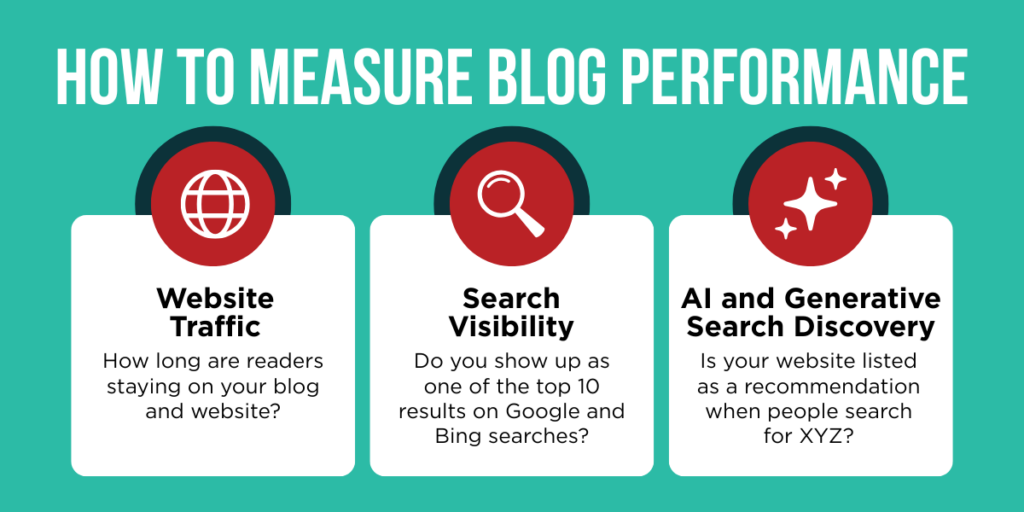
Website Traffic: The Starting Point
Website traffic is often the first indicator of whether your blog is gaining visibility. Tools such as Google Analytics help you understand how readers arrive on your site, how long they stay and which posts attract the most interest. These insights show whether your content is reaching the audience you intend and whether your topics are connecting with real search behavior or promotional efforts.
Looking at traffic patterns over weeks or months provides a clearer picture than focusing on single-day spikes. Consistent review shows which channels, such as organic search, social media, email or referral links, are driving qualified visitors. It also helps identify trends such as seasonal interest or the steady growth that comes from publishing useful, relevant content. When you understand how traffic moves across your blog, you can make informed decisions about your publishing schedule, promotion and long-term content strategy.
Search Visibility: Is Your Blog Supporting SEO?
Search visibility refers to how often your blog appears in search engine results when people look for information related to your topic. In other words, it reflects how easy it is for potential readers to find your content through search engines such as Google or Bing. When posts are built around clear, specific topics, they are more likely to appear in search results and attract readers actively seeking that information.
Tools such as Google Search Console and Bing Webmaster Tools help measure this visibility. These platforms show which search queries lead users to your posts, how often those posts appear in results and how frequently users click through to your site. Together, these metrics help you evaluate if your search engine optimization (SEO) strategy is effectively connecting your content with the right audience.
According to digital marketing expert Neil Patel, AI tools such as Google’s generative search features often draw from content that already ranks well in search results. This makes strong search visibility an important foundation for broader discovery across both traditional search engines and AI-assisted platforms.
These insights help determine whether your content is building credibility and consistent visibility in search results over time. When blog posts regularly appear for relevant searches, it signals to search engines that your website is a reliable source of information on that topic. If impressions are low or certain posts rarely appear in search results, it may indicate that the topic is too broad, too competitive or not clearly defined. Search data also highlights which subjects resonate most with your audience, allowing you to build future content around proven interest. Strong search visibility signals that your blog is answering meaningful questions in a way search engines can understand and users find helpful.
How to Improve Search and AI Ranking
To improve search visibility, you need to make your content easier for readers, search engines and AI systems to understand. Clear structure, focused topics and accurate information help search tools identify the purpose of your post and match it with the right audience. Google increasingly evaluates content using principles known as EEAT: Experience, Expertise, Authoritativeness and Trustworthiness. Content that demonstrates real knowledge, provides thorough information and presents ideas clearly is more likely to perform well in both traditional search results and AI-assisted discovery tools.
Here are some practical ways to strengthen your chances of appearing in search results and AI-generated summaries.
- Focus each blog post on one clearly defined topic or question. Narrow, well-defined subjects help search engines understand the purpose of your content and match it with relevant searches.
- Use headings that match the phrasing your audience uses when searching. Clear subheadings improve readability for readers while helping search engines interpret the structure of your content.
- Provide comprehensive answers supported by data and examples. Longer, well-developed posts that include research, statistics or practical insights often perform better than short posts that only briefly summarize a topic.
- Demonstrate expertise through real examples. Case studies, professional insights or examples from real projects help reinforce EEAT signals and show that your content is based on genuine experience.
- Incorporate mixed media to create a richer content experience. Videos, infographics, charts, downloadable guides or visual summaries can improve engagement while also giving search engines additional signals about the value of your content.
- Update outdated blog posts to maintain accuracy and relevance. Refreshing statistics, expanding sections or adding new insights can help existing posts remain competitive in search results.
- Ensure your site loads quickly and performs well on mobile devices. Technical performance remains an important factor in both search rankings and overall user experience.
When blog posts combine strong expertise, clear organization and helpful supporting resources, they are more likely to perform well across search engines and emerging AI-driven discovery platforms.
AI and Generative Discovery: The Next Layer of Visibility
AI-assisted discovery has changed the way users find information online. Instead of relying only on traditional search results, tools such as Google Gemini scan large amounts of content to identify the clearest and most helpful sources. These tools look for direct answers, strong organization and content that includes enough context for an accurate summary. Neil Patel says that these models favor content with clear structure and depth, making well-organized blog posts more likely to be referenced. When an AI model generates a response for a user, it often draws on websites that consistently demonstrate clarity and subject-matter expertise.
As AI-powered search continues to evolve, analytics tools are adapting to help businesses track this type of visibility. For example, Bing Webmaster Tools now provides data that helps identify how content performs within AI-driven experiences such as ChatGPT, offering insights into how often pages appear and how users discover them through generative search environments.
How to Improve Visibility in AI-Assisted Search
AI models look for content that is easy to interpret, clearly organized and backed by reliable information. Importantly, these systems do not evaluate a single blog post in isolation. AI discovery tools often scan a wide range of information connected to your business, including your website content, blog posts, online reviews, social media profiles and other public sources. They look for consistency, expertise and authority across these signals to determine whether a business is a credible source of information.
Blogs play an important role in this process. While traditional website pages often focus on services or products, blog content provides space to answer detailed questions, explain industry topics and address common concerns that potential customers may be searching for. This type of informative content helps demonstrate expertise and provides AI systems with clear context about what your business knows and how it helps its audience.
Small adjustments to structure and clarity can increase the likelihood that your blog will be included in AI-generated summaries or recommendations. Here are some tips to strengthen your visibility across AI-assisted discovery tools.
- Answer questions directly and early in the article. AI systems often prioritize content that provides clear, concise answers near the beginning of a page.
- Use clear subheadings that show structure and guide readers logically through the content. Strong organization makes it easier for both readers and AI tools to understand how information is presented.
- Avoid vague language and prioritize specificity when explaining concepts or giving advice. Precise wording improves clarity and reduces the risk of misinterpretation.
- Support claims with data, examples or credible references to demonstrate authority. Evidence-based content strengthens credibility signals across both search engines and AI tools.
- Organize content logically so the information readers are looking for can be found quickly. Clear structure improves both user experience and AI interpretation.
Blog Performance Is Measured Holistically
Measuring blog performance requires looking at the full picture. Traffic, search visibility and emerging AI discovery trends work together to show how well your content supports long-term marketing goals. Reviewing these areas consistently helps you refine your strategy, identify opportunities for improvement and avoid making decisions based on short-term fluctuations.
Here are a few practical steps to guide your review process.
Step 1. Measure your traffic.
Use a tool such as Google Analytics to understand how readers reach your content, which posts attract attention and how engagement changes over time.
Step 2. Evaluate your search visibility.
Review data in Google Search Console or Bing Webmaster Tools to see which queries lead users to your site, which posts appear in results and where you may need clearer or more focused topics.
Step 3. Consider how your content performs in AI discovery.
Assess whether your posts are clearly structured, answer well-defined questions and provide enough context for AI models to summarize accurately.
These steps give you a more complete view of your blog’s impact and help you make adjustments that support long-term growth.
Trust the Experts
If you need help interpreting your analytics or building a strategy around them, the team at Fiore Communications can provide guidance tailored to your goals. Successful marketing doesn’t happen by accident; it is accomplished through effective strategy, consistency and connection.
As a full-service marketing agency, Fiore Communications offers integrated services in content marketing, digital marketing and creative development. For organizations looking for a starting point, our marketing packages provide focused solutions for launching a new business, strengthening social media visibility or starting a podcast without the long-term agency commitment.
Ready to strengthen your blog strategy and measure performance with more clarity? Let’s start the conversation. Call (850) 668-0510 or contact us online to get started today.